

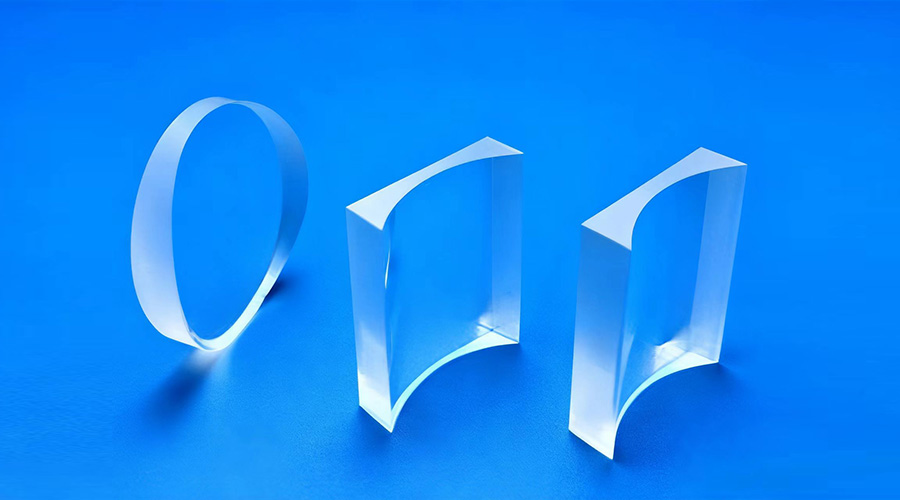
Negative Cylindrical Lens (Diverging Cylindrical Lens)

Home ProductsPrecision Optical ComponentsCylindrical lensesNegative Cylindrical Lens (Diverging Cylindrical Lens)
Specifications

They diverge light only in the curvature direction. Common types include plano-concave and bi-concave lenses, mostly used for beam expansion and aberration correction. Negative cylindrical lenses work oppositely to positive ones: they achieve unidirectional divergence by bending light toward the thinner edge, with a virtual focal line.

  • Structure: At least one surface is a concave cylinder (recessed along one direction). In the recessed (curvature) direction, the lens is thinner at the center and thicker at the edges. In the perpendicular (non-curvature) direction, it remains flat with uniform thickness.
  • Optical Principle: When parallel light is incident: In the curvature direction, edge rays pass through a thicker region, while central rays pass through a thinner region. After refraction, rays bend toward the edges (thinner ends), and the output beam becomes divergent. Extending these divergent rays backward forms a virtual focal line on the incident side (not physically detectable, only a virtual starting point for imaging). In the non-curvature direction, light propagation is unaffected, remaining parallel input and parallel output.

Cooperation Inquiry

*
*
*
*
*
*