
-
Axicon
-
Glass axicon (commonly referred to as cone lens or axicon prism) is a special optical component. Its conical geometric structure can convert incident light into annular beams or Bessel beams distributed along the optical axis, achieving optical effects unavailable with conventional lenses, such as non-diffracting propagation, self-healing, and long focal depth. With its unique conical structure, the glass axicon provides beam control capabilities beyond traditional optical elements, especially excellent performance in generating non-diffracting Bessel beams. This makes it an indispensable core component in modern optical engineering, including precision machining, life sciences, beam shaping, and high-precision measurement.
-

Concave axicon
Concave axicon (usually called negative axicon or concave cone lens) has an inward recessed central curved surface. Its main function is to diverge light rays. When parallel light is incident vertical..
-
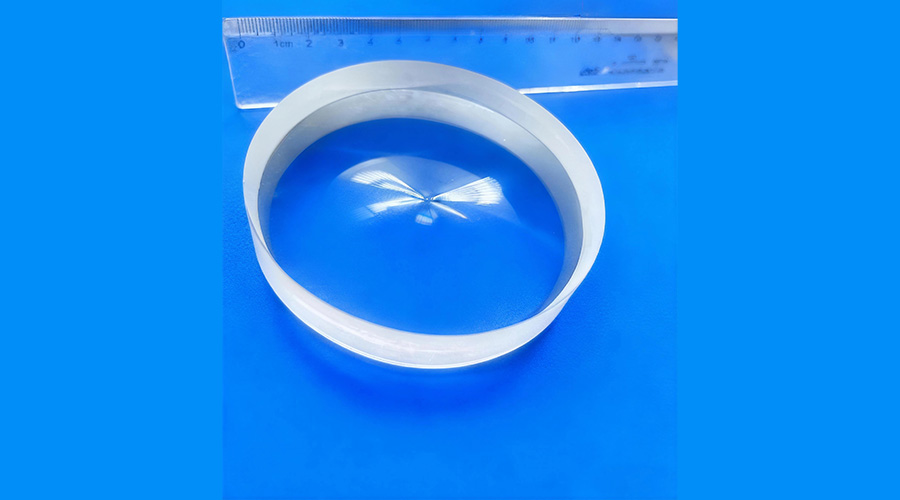
Convex axicon
Convex axicon (commonly known as cone lens or axicon prism) has a centrally outward convex surface. Its core function is to converge light rays, but unlike conventional lenses that focus to a single p..
-