
-
Cylindrical lenses
-
Cylindrical lenses are optical components with a cylindrical surface structure. Cylindrical lenses exert a directional effect on light rays. When a parallel beam is incident, a cylindrical lens focuses or diverges light along the curved direction, converging the light into a straight line. Its imaging principle is based on light refraction. By precisely controlling the curvature of the curved surface, it can eliminate spherical aberration of conventional spherical lenses and form a focal line instead of a focal point on the focusing axis.
Structural Features: As an aspherical lens, it has curvature in only one direction and remains flat in the perpendicular direction. Its cross-section can be plano-convex, plano-concave, bi-convex, bi-concave, and other forms.
Material & Process: Made of optical glass. Processing methods: grinding and polishing, suitable for small-batch production; glass molding, suitable for mass production.
- Applications: Widely used in laser technology, industrial inspection and measurement, medical and biotechnology, consumer electronics, office equipment, and other fields.-
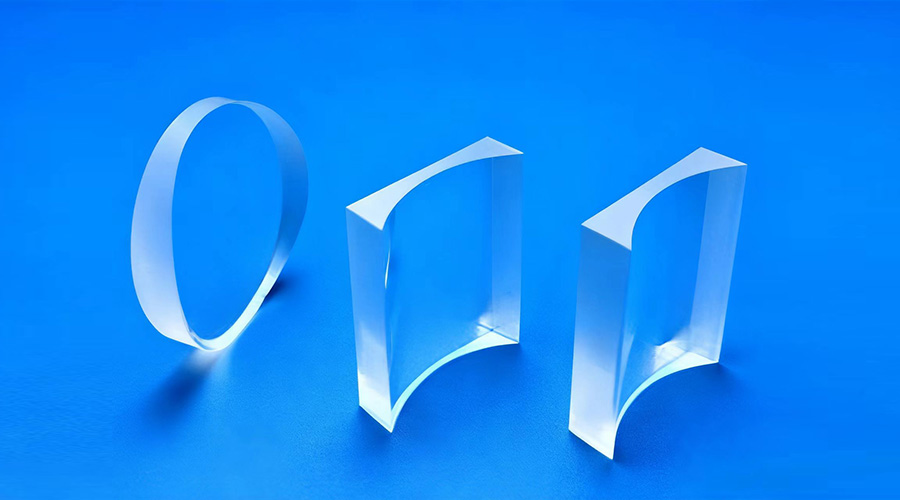
Negative Cylindrical Lens (Diverging Cylindrical Lens)
They diverge light only in the curvature direction. Common types include plano-concave and bi-concave lenses, mostly used for beam expansion and aberration correction. Negative cylindrical lenses work..
-

Positive Cylindrical Lens (Converging Cylindrical Lens)
They converge light only in the curvature direction. Common types include plano-convex and bi-convex lenses, widely used in laser collimation, beam focusing, and other applications. The core of a posi..
-